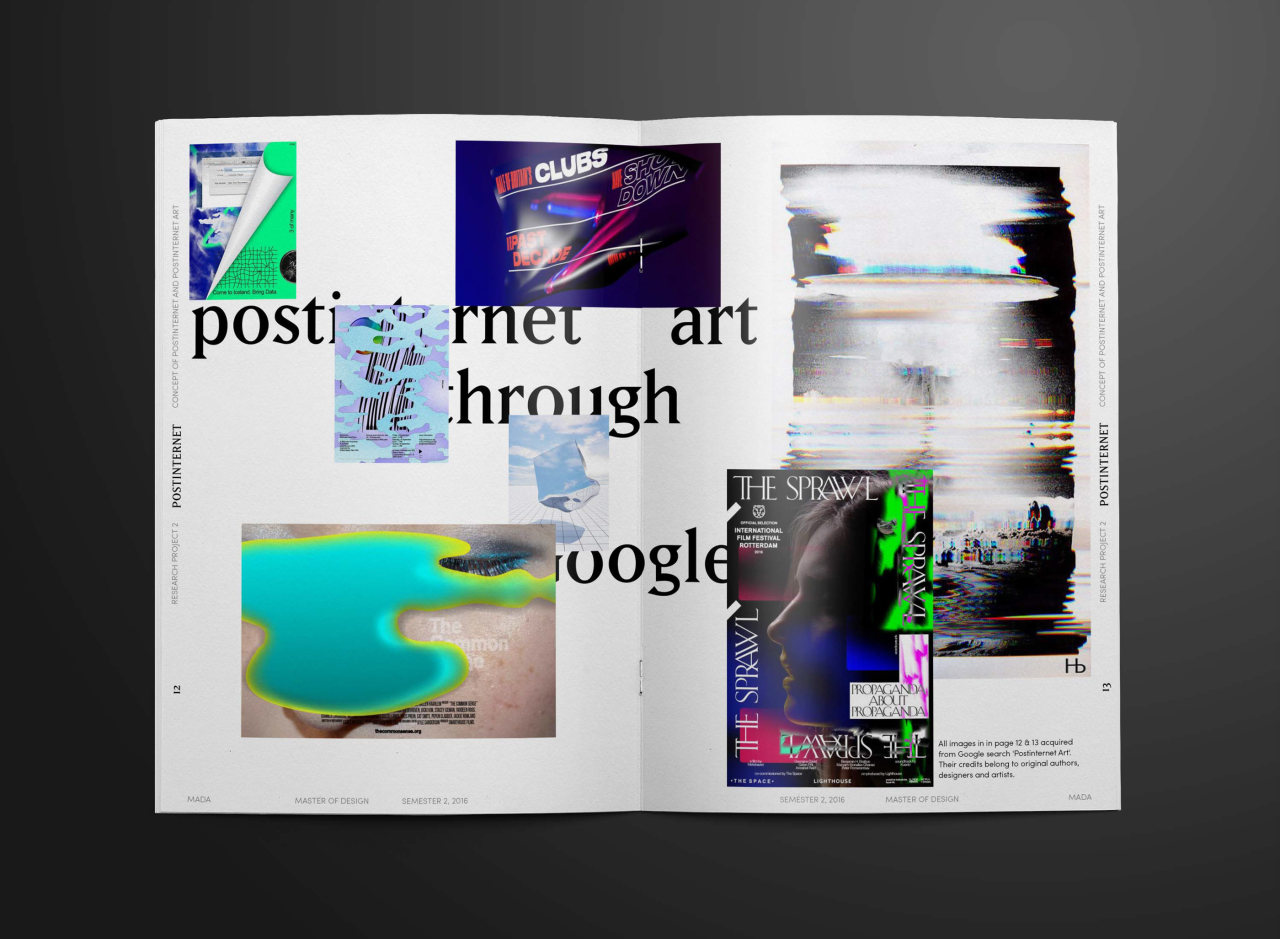
Brief
You will produce x-number of printed and assembled zines (one for each member of the class + one for you + one for the instructor) that consist of at least 12 pages (including the cover) that takes Post-Internet concepts as its theme. There should be some typographic elements included as well. The paper selection, size, printing method, and subject matter are up to you, but you must use Riso in some form—either as the cover, or as interior pages. This is the only assignment where the use of AI/LLM is allowed, but the student must submit a written note explaining where the AI/LLM was used and how it was appropriate to their overall concept.
Your zine design should incorporate at least three different features from the list below that are germane to the concept.
- Die cut (it can be hand cut or laser cut). This can include rounded corners or other cuts that create flaps or negative space.
- Two or more different paper types/weights/colors/finishes or materials such as davey board, fabric, plastic, metal, and more.
- A non-inkjet-print/photostatic/laserprint process (it may include one of the standard processes, but ALSO include one of the non-standard processes below)
- Consider lithography, Riso, relief printing, etching, foil, UV coating, gloss, silkscreen, stamping, and more.
- A non-staple binding or non-traditional cover
- This may include, but is not limited the following bindings: stitching, perfect binding, rubber bands, spiral binding, binder clips, and bolts.
- Intentionally misaligned/differently sized paper or fold outs
- Pop up element(s) or movable parts (aside from the typical hinge at the spine)
- Paste ins
- A pocket, envelope, or box to house the zine
- A bleed (this means you will have to trim the edges of the zine and take this into account in your design)
What to Do
- Include your name somewhere in the publication.
- Be playful. Think about how you can experiment with formats, paper types, printing processes, colors, and image-making methods.
- Think about what Post-Internet means and what it means to address digital culture in an analog format (printed zine). Select an appropriate theme/concept/subject.
- Think about how typography (not hand lettering) will play a role. It can be minor, but it should be present and fully considered. What are Post-Internet typefaces?
- Remember that everyone will receive a copy of this, so don’t make something ill conceived and poorly executed.
- Refer to this Pinterest board for inspiration.
- How might you plan, design, and execute something you are proud of?
- Make a mock-up before you fully execute to make sure pages are in the right order, you’ve considered all the pitfalls, and you know how to actually make and assemble the zine.
Grading
Assignment grades will be based on the following:
- Conceptual Concerns (40%)
-
Student demonstrates evidence that they understand and inventively integrate conceptual concerns and implications of print and web design.
- Excellent: Student demonstrates conversational familiarity with the material—making interesting connections between ideas, readings, and presentations.
- Average: Student is able to recall and recite material, but not do anything interesting with it.
- Below Average: Student struggles to demonstrate a grasp of the material and shows no facility in connecting ideas or new thinking.
- Execution (40%)
-
When executing a project, the student demonstrates a firm grasp of the materials, techniques, hardware, and software. The student’s skills and approach are appropriate to their concept. In written/oral assignments, this includes proper spelling, punctuation, sentence structure, grammar and formatting for written assignments; and annunciation, confidence and focused arguments for oral assignments.
- Excellent: Student displays skills and sensitivity when creating projects. The level of craft and approach to making is appropriate to the concept. In written/oral assignments, student understands writing and presentation modes including style guides and oral confidence and is able to nimbly employ these tools in their art projects, writing, and speaking.
- Average: Student work shows some flaws in their understanding of materials and skills. Stylistic and formatting mistakes are present.
- Below Average: The execution is unconsidered and hasty. Student repeatedly makes the same mistakes and ignores instructor input and suggestions.
- Assessment/Critique (10%)
-
The student will produce a self-evaluation for each art project including the strengths and weaknesses of a given work and plans for future improvement. This will also include an accounting of time taken. The student will also be present for and participate in group critiques of projects.
- Excellent: The student thoughtfully and honestly engages in the self-reflective process of critiquing their own work and efforts. The student enthusiastically engages with group critiques, seeking ways to offer constructive feedback to other students.
- Average: The student performs a cursory and surface-level assessment of their work and efforts. They make neutral comments during the group critiques and do not fully engage.
- Below Average: The student demonstrates an inability to honestly engage with their work as it exists in the world, and does not adequately participate in group critiques, or is absent/tardy.
- Following Instructions (10%)
-
The student adheres to the guidelines provided for the course and the assignment. If the paper has a particular framework, the student adheres to that framework. If an assignment is to be submitted as a Word doc on Learning Suite, the student does not email the instructor a PDF.
- Excellent: A detail-oriented student who takes instruction and fastidiously executes it within their work.
- Average: A student who misses some details because they didn’t read instructions thoroughly or take proper notes when instructions were given.
- Below Average: Student ignores basic instructions and guidance given for assignments.
- On-time Submission
-
Projects lose 5 points (our of 100) per 24-hour period they are late. If an assignment is submitted 5 minutes late, that is within the first 24-hour period, so it loses 5 points. If it is 27 hours late, that puts it in the second 24-hour perdiod, so it loses 10 points.
Learning Outcomes Addressed
- Design Fundamentals and Processes
Students will be able to implement the steps that guide a designer to effective solutions, apply compositional skills to design problems, and employ fundamentals of 2D design such as grid systems and the basics of typography.
- Technical Proficiency
Students will be able to employ the technical fundamentals of print and web design and production.